Aravind Adiga's The White Tiger, which won the Booker Prize in 2008, is told entirely by its central character, Balram Halwai. Everything we learn about Balram, his family, his employers and India comes through his voice, and that voice is witty, angry, self-justifying and often unsettling. To write well about the novel, you need to read Balram not just as a character but as a narrator who is shaping the story for his own purposes.
The story in brief
Balram grows up in poverty in the village of Laxmangarh, in what he calls the Darkness. He is taken out of school to work and eventually becomes a driver for a wealthy family, serving Mr Ashok, who has returned from America with his wife, Pinky Madam. In Delhi, Balram sees the vast gulf between rich and poor, and the corruption that connects them. In the end he murders Ashok, steals a large sum of money and escapes to Bangalore, where he becomes a successful entrepreneur. He knows that his family is likely to suffer terrible reprisals for his crime.
A novel in letters
Balram tells his story in a series of letters to the Chinese Premier, written over several nights. This choice of form matters for several reasons:
- It allows Balram to present himself as an expert explaining India to an important foreign visitor.
- It gives his voice a conversational, confiding quality, as if we are overhearing a private confession.
- It lets Adiga satirise India's image of itself, with Balram mocking official stories of progress.
- It frames the whole novel as Balram's version of events, told after he has already "succeeded".
Is Balram a reliable narrator?
An unreliable narrator is one whose account we cannot fully trust, because of bias, limited knowledge, self-interest or a deliberate wish to persuade. Balram is a good example. He is clear-sighted and funny about the hypocrisy of the rich, but he is also justifying a murder.
When you write about him, look for moments where:
- He presents his crime as a kind of liberation, or as the only way out.
- He invites us to admire his cleverness and enterprise.
- His tone becomes defensive, boastful or evasive.
- What he tells us about himself conflicts with how he has behaved.
This does not mean that everything Balram says about inequality is untrue. Adiga uses him to expose real injustice. The challenge, and the interest, is that a narrator can be right about society and still not be someone we should simply trust or admire.
The Rooster Coop
One of the novel's central images is the Rooster Coop. Balram compares India's poor to roosters in a market coop who can see their fellow birds being slaughtered but do not try to escape. The image explains, in his view, why servants remain loyal to masters who exploit them: they are trapped by family obligations, fear and habit.
For revision: think about how the Rooster Coop connects to Balram's decision. He presents his crime as breaking out of the coop. Ask whether the novel supports that view, questions it, or does both.
Light and Darkness
Balram divides India into the Light, the prosperous urban India, and the Darkness, the poor rural interior where he grew up. This division is a useful starting point, but notice how Adiga complicates it. Corruption and cruelty exist in the cities as much as in the villages, and the Light is built on the labour of people from the Darkness.
The white tiger
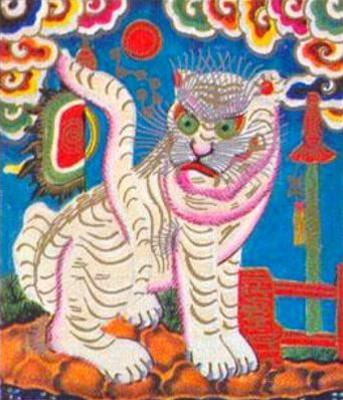
The title comes from the moment when a school inspector calls the young Balram a "white tiger", a creature that appears only once in a generation. Balram embraces this identity. It flatters him as exceptional, but it also isolates him and arguably encourages his belief that ordinary rules do not apply to him.
Humour and satire
The novel is often very funny, and Balram's humour is part of its power. His sarcastic commentary on politicians, religion, democracy and the rich makes the reader laugh while exposing serious injustice. Satire uses humour to criticise; when you discuss a funny passage, always explain what it is criticising.
Writing about Balram
- Refer to Balram as narrator and character: "As narrator, Balram presents..."
- Avoid taking his claims at face value; use phrases such as "Balram insists", "he would have us believe" or "he justifies".
- Balance his insight into injustice with his moral failures.
- Use short references rather than long quotations, and paraphrase where you are unsure of the exact wording.
Revision tip: the most interesting essays on this novel hold two ideas at once: Balram is a victim of a cruel system and also a murderer who profits from his crime.
The difference between a narrator and an author is a close relative of the speaker-poet distinction, explained in Speaker vs Poet: Why the Difference Matters. If you have studied the dramatic monologue, Balram will remind you of the self-revealing speakers discussed in The Dramatic Monologue: Ulysses and Stealing. For other setworks, see Brave New World: Stability, Happiness and Control.
Members can find full The White Tiger video lessons and PowerPoints through the membership options.
Go Further with the The White Tiger Course
Video lessons, PowerPoints and essay guidance for every part of The White Tiger, taught by Kate.